
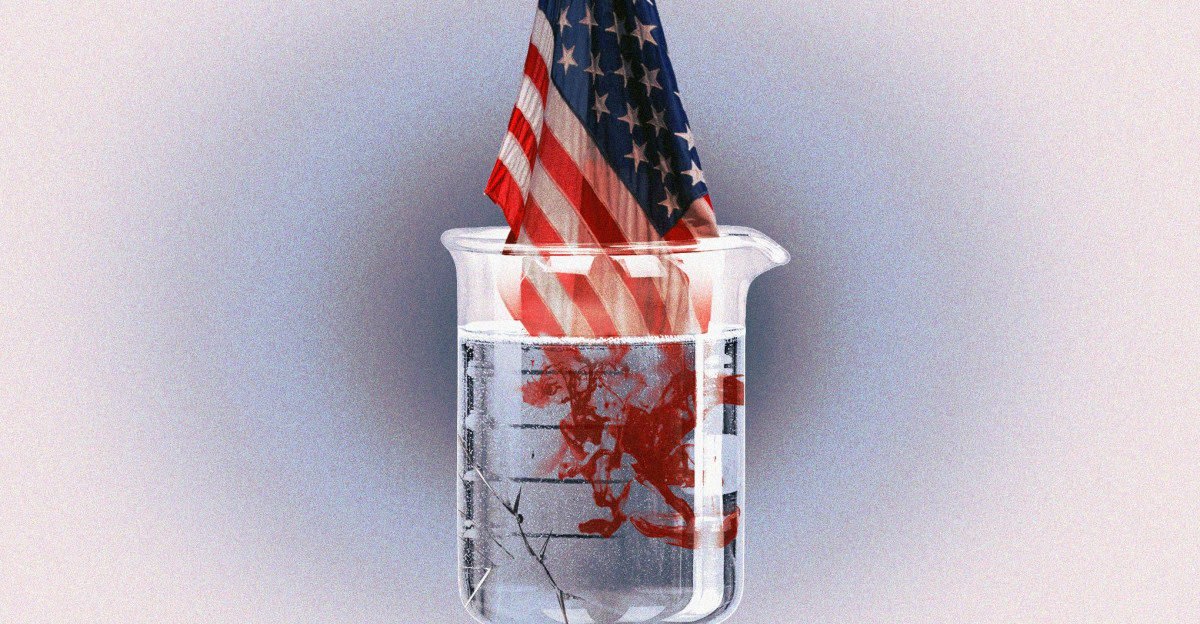
A grave threat looms over the future of scientific research in the United States. Under the guise of subtle rule changes, the landscape of American science could be fundamentally altered, affecting thousands of scientists and millions of citizens alike. Yet, there remains a window of opportunity to challenge this impending transformation.
On May 29th, the Office of Management and Budget (OMB) unveiled a 412-page proposal aiming to revise federal financial assistance. The document is a peculiar blend of "Trumpian" attacks on so-called "woke" policies and dense governmental jargon designed to obscure its true implications. Hidden beneath phrases like "providing further clarification on the regulatory status of the OMB requirements" lies a darker intent: a direct threat to scientific inquiry, the livelihoods of countless researchers, and the well-being of vulnerable populations across the nation.
Colette Delawalla, founder and CEO of Stand Up for Science, warns that if these rule changes proceed, science in the US "will stop... It won’t exist anymore." However, the OMB is legally obligated to review and address all substantive public comments, with the submission deadline set for July 13th. An alternative path exists: a Congressional objection could also halt the implementation of these changes.
The proposed rule would usher in unprecedented political oversight over more than $1 trillion in federal grants disbursed across 42 diverse agencies. These grants are the lifeblood of most scientific research and the salaries of researchers at universities nationwide, funding everything from vaccine development to natural hazard studies. If passed, political appointees would gain the power to review and veto any grant, for any reason, at any time. Scientists could face severe restrictions on international collaboration, require pre-approval for conference attendance, and be barred from using research funds to publish their findings for public access.
A core tenet of the new rule dictates that all federal grants must align with "the President’s policy priorities," while any mention of "DEI" (diversity, equity, and inclusion) or "gender ideology" would be immediately prohibited. The document starkly implies that applicants unable to meet these demands are free to seek funding elsewhere – effectively, "if you don't like it, leave." Jeremy Berg, former editor-in-chief of the Science journals, refutes the premise, stating, "Saying that the NIH or NSF or whoever has been funding neo-Marxist things, that’s not evidence. That’s not a reason. That’s nonsense."
While scientists are vocally expressing their concerns, the impact extends far beyond the scientific community. The proposed rule would encompass agencies spanning Education, Veterans Affairs, Housing and Urban Development, NASA, and Health and Human Services. All these entities offer federal grants that fund vital programs, from mental healthcare access to low-income housing initiatives and Head Start programs.
The repercussions of the previous Trump administration on scientific research have already been deeply felt, marked by grant cancellations, delays, and a worrying decline in graduate student enrollment at top institutions. Traditionally, the integrity of scientific research has been safeguarded by rigorous peer review. At the National Institutes of Health (NIH) and the National Science Foundation (NSF), grant proposals undergo a multi-layered evaluation by scientific experts. Jeremy Berg explains, "It’s looked at by three scientists on a study section who read the proposal fairly carefully and write critiques, and then it’s discussed at the study section meeting, and that gets a score based on that, and then that goes to advisory councils." Only the highest-scoring proposals, aligning with top research priorities, receive funding in a fiercely competitive environment where only 8 to 20 percent of grants are funded annually.
While institute directors historically held advisory roles and could intervene, the scientific merit generally held sway. Berg recalls, "When you were just in basic science, there really wasn’t much politics at all," save for a few highly specific, politically charged issues like embryonic stem cell research. He warns that allowing politics to override science can have deadly consequences, referencing the Reagan administration's delayed response to the AIDS crisis, which he believes "probably killed a lot of people." Donna Riley, dean of engineering at the University of New Mexico and former NSF program officer, affirms that the "vision was that the science needs to be insulated so that the best ideas get funded, period." Jacquelyn Gill, a paleoecologist at the University of Maine, highlights that since World War II, "the priorities for the National Science Foundation emerge from the scientific community," fostering trust and stability irrespective of political shifts. It's a system that has yielded remarkable fruits, with Google having origins in an NSF grant and over 100 Nobel laureates having conducted work at or been supported by NIH funding.
The crux of the OMB's 412-page proposal lies in a seemingly minor yet profoundly impactful word change. Joanne Padrón Carney, chief government relations officer at the American Association for the Advancement of Science, explains, "What OMB is recommending is that they change this from just a simple guidance to a regulatory policy." This shift "puts in place a whole expansive authority over agencies and their procedures and their priorities when it comes to funding scientific research." The transformation from non-binding guidelines to formal regulatory policy means these changes would be incredibly difficult to reverse, "essentially cement[ing] these changes into regulation," requiring a formal rulemaking process and a future administration committed to undoing them.
The rule change document is remarkably candid about its motivations, stating that "in 2021 Federal agencies became increasingly focused on using their award programs to serve a 'woke' policy agenda." The new review level aims to ensure grants "advance the President’s policy priorities," reinforcing President Trump’s Executive Order 14332 and echoing the "Gold Standard Science" touted in Executive Order 14303. Gill criticizes this, noting that the concept of a "gold standard of peer review" already exists and is well-defined, unlike the vague new directive.
In a move reflecting the administration’s focus on "DEI" and transgender issues, part of this "Gold Standard" explicitly forbids agencies from funding diversity initiatives, mandates acceptance of "the biological reality of sex or the sex binary in humans," and prohibits federal grants that promote "the so-called ‘“transition’” of a child under 19 years of age from one sex to another." This translates directly to an absence of research grants for health equity for people of color or the LGBTQIA+ community, many of which, including clinical trials, have already been cancelled. The article poignantly asks, "Why use a dog whistle when you can simply scream?" The OMB has not responded to requests for comment.
Elizabeth Ginexi, a former scientific program officer at the NIH for 22 years, highlights the drastic shift in grant cancellations. "At the NIH, when we’ve canceled grants in the past, it has been usually when there’s been extreme scientific misconduct or something like that where there’s been fraud, lying, scientific malfeasance," she explains. "It was never ‘I don’t really like the topic of your grant.’"
Further restrictions include requiring pre-approval for scientists to attend conferences, a process that Gill notes sounds fiscally responsible but ignores the vital role conferences play in fostering collaboration and emergent research needs. Similarly, the rule prohibits using federal funds to publish findings. Given that open-access journals can charge thousands of dollars per paper, and the Biden administration previously mandated open access for federally funded research, this creates an impossible bind for many scientists who lack alternative funding sources, potentially forcing them to publish less or in less accessible journals.
Collaborations, both domestic and international, are also at severe risk. The vague wording in the rule prohibits using federal money to collaborate with "foreign adversaries," but Delawalla points out the ambiguity: "It doesn’t say people, it’s parties... We don’t know if that means an individual scientist, if it means a university, if it means a country." Such ambiguity could sever critical lines of communication, even those beneficial to national security, like the daily US-China satellite collision avoidance collaboration. Padrón Carney adds that the vague terms like "gold standard science," "anti-American," and "domestic first" will be subject to arbitrary interpretation by unelected officials, posing a particular threat to the 19% of STEM workers and 43% of PhD-level scientists who are international.
Delawalla and Stand Up for Science launched a public campaign after the "Gold Standard Science" executive order in May 2025, warning that the government was attempting to seize control of scientific research, though many initially dismissed their concerns as "extreme." However, the impacts are already tangible. Ginexi cites the cancellation of an NIH grant application request for HIV/AIDS research, aimed at finding a cure using mRNA technology, due to skepticism from the Trump administration. "We could have literally had a vaccine ready so that no one would get AIDS anymore," she laments.
The widespread cancellations and program cuts are already pushing scientists out of the field. A letter published in JAMA on June 8th indicated that the number of scientists supported by federal grants dropped in 2025 for the first time since 2016, with Black and Hispanic scientists experiencing the most significant declines. Berg notes that "People who come from minority communities tend to work on subjects related to health disparities or other things," and these programs were among the first to be targeted. The long-term consequence is dire: "We’re going to lose the future of our science pipeline. We will basically no longer be doing much science in the U.S. at all." The uncertainty of funding also places immense pressure on researchers, many of whom rely on grants to pay salaries for graduate students and technicians, leading to shrinking graduate programs at institutions like MIT.
أجندة 'مناهضة اليقظة': تهديد وشيك لمستقبل البحث العلمي الأمريكي
مقترح مثير للجدل صادر عن مكتب الإدارة والميزانية (OMB) يهدد بتسييس أكثر من تريليون دولار من المنح العلمية الفيدرالية الأمريكية، مما يسمح للمعينين السياسيين بنقض الأبحاث بناءً على أجندات 'مناهضة اليقظة'. هذا التغيير الشامل يعرض الابتكار العلمي والتعاون الدولي والأبحاث الحيوية للخطر عبر 42 وكالة، مع تداعيات عميقة على كل مجتمع أمريكي. اكتشف كيف يمكن أن يعيد هذا تشكيل مستقبل العلوم في الولايات المتحدة ولماذا لا يزال هناك وقت للتحرك.
سياسة العلوم، السياسة الأمريكية، البحث والابتكار
المصدر: عرض الخبر الأصلي


 مرحبا، أسمي زين وهذه مدونتي أسعى دائما لأقدم لكم أفضل المواضيع الخاصة بالتكنلوجيا
ليست هناك تعليقات:
إرسال تعليق